Computational science · mechanical engineering
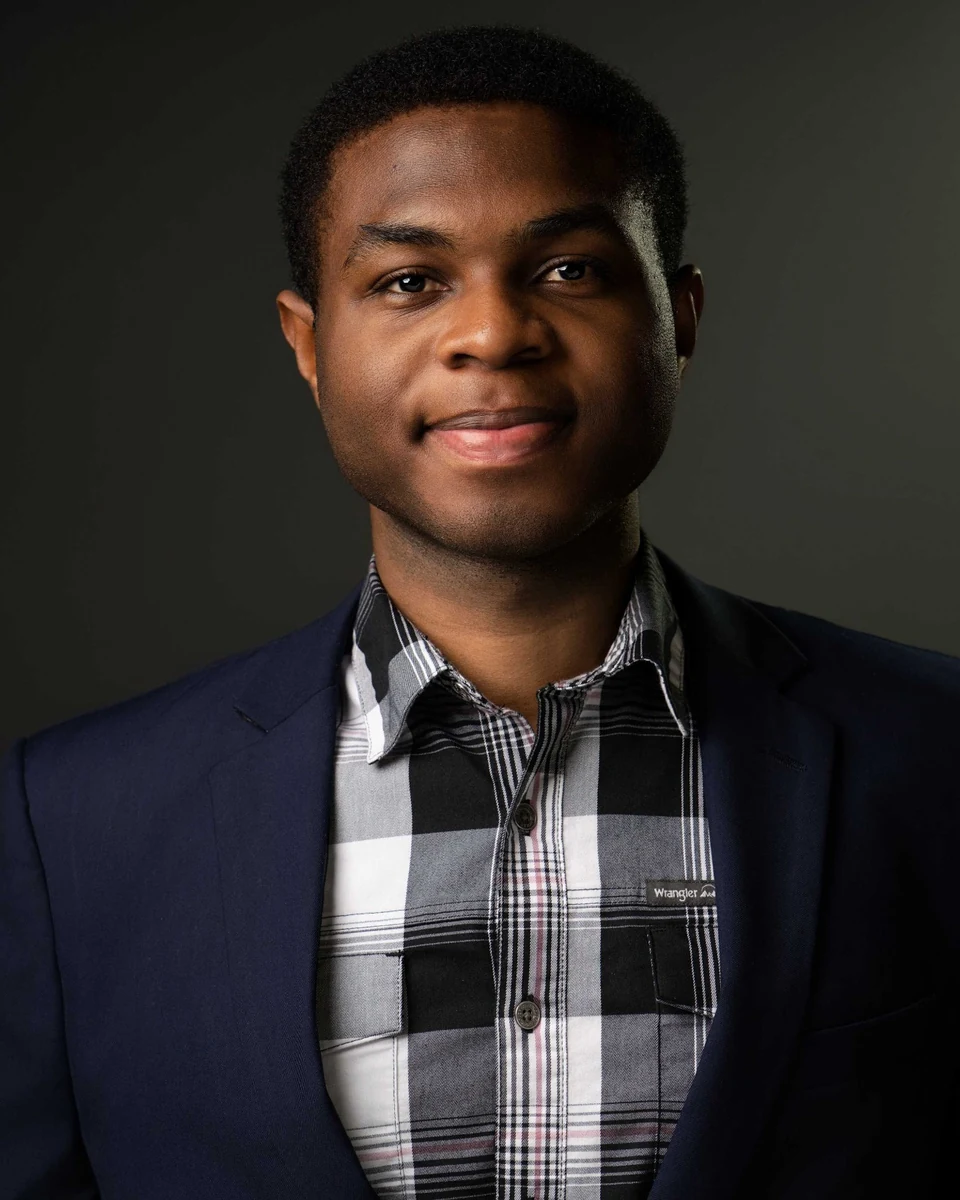
James Afful
Computational Scientist & Mechanical Engineer
Ph.D. candidate at Iowa State University working in computational fluid dynamics, high-performance computing, scientific machine learning, and research software for engineering and physical systems.
Research and engineering with traceable outputs.
The portfolio emphasizes work that can be tied to publications, public proceedings, documented professional service, or reproducible software.
Classroom airflow, ventilation, and simulation-ready geometry
Scalable CFD workflows for K–12 indoor airflow, including real-space reconstruction, meshing, RANS/LES analysis, and contaminant transport on large computational meshes.
High-fidelity CFD at Lawrence Livermore National Laboratory
Developed and validated CFD models for isotope-separation problems under ultra-high-vacuum conditions using ANSYS Fluent on LLNL computing resources.
3D plant reconstruction with Neural Radiance Fields
Co-authored peer-reviewed work evaluating NeRF methods against LiDAR ground truth for plant geometry reconstruction in increasingly realistic environments.
PhySiViT: a vision transformer for physics simulations
Co-developed a domain-focused foundation model for scientific simulation imagery. The work was archived as an SC’25 research poster and compared against DINOv2 and CLIP baselines.
Scientific simulation software and reproducible workflows
Building research software for APSIM simulation, experiment planning, model qualification, provenance, and evidence-supported decision workflows.
Publication, computing, and service.
2025 US-RSE Community Awards Committee
Selected to review and score nominations and participate in awards deliberations for the United States Research Software Engineer Association.
International High Performance Computing Summer School
Selected for the 2024 program in Kobe, Japan, with training in MPI/OpenMP, GPU programming, performance analysis, scientific visualization, and large-data workflows.
Methods and tools.
Computational methods
CFD, finite element methods, RANS/LES, heat and mass transfer, multiphysics, numerical simulation
High-performance computing
MPI, OpenMP, Linux, Frontera, Stampede3, Nova, Docker, Singularity, AWS, Azure
Programming & software
Python, C++, MATLAB, Bash, Git, ANSYS Fluent, OpenFOAM, MFEM, EnergyPlus, ParaView
Scientific machine learning
PyTorch, neural networks, NeRF, reinforcement learning, symbolic regression, XGBoost, Bayesian optimization
Research, engineering, and scientific-computing opportunities.
Ames, Iowa · jamezafful@gmail.com